Orbital Dynamics & Planet Formation
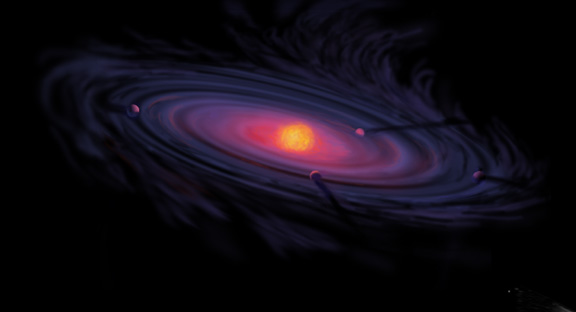
The orbital architectures of observed planetary systems encode information about their formation and dynamical histories. We use N-body simulations, analytic theory, and statistical comparisons with observations to understand the processes that shape planetary systems.

Key Projects
Giant Planets around M Dwarfs
The existence of Jupiter- and Neptune-mass planets around very low-mass stars places strong constraints on core-accretion and disk-instability models. We study these systems theoretically and in connection with the Searching for GEMS (Giant Exoplanets around M-dwarf Stars) survey, which uses TESS photometry and radial velocity follow-up to measure the occurrence and bulk properties of giant planets around low-mass stars (Stefansson et al. 2023; Kanodia et al. 2024).
Spin-Orbit Angles & Rossiter-McLaughlin Measurements
We measure the alignment between planetary orbits and their host star's rotation axis using the Rossiter-McLaughlin effect with NEID and HPF. These measurements reveal how planets arrived at their current orbits: well-aligned systems suggest quiescent disk migration, while misaligned or polar orbits point to dynamical processes such as Kozai-Lidov oscillations or planet-planet scattering. Recent results include a polar orbit for the warm Neptune GJ 3470b and well-aligned warm Jupiters in unusual binary configurations.
Planet-Planet Scattering
Gravitational scattering between giant planets during the late stages of system assembly can produce the eccentric and hot Jupiters we observe today. We use N-body simulations and statistical comparisons with observed eccentricity distributions to quantify how often scattering occurs and what outcomes it produces, building on early work showing that planet-planet scattering is a key channel for generating hot-Jupiters and the broad eccentricity distribution of giant exoplanets (Rasio & Ford 1996; Ford & Rasio 2008; Chatterjee et al. 2008).
Migration Traps & the Kepler Dichotomy
Pebble-accretion and migration simulations show that planet traps near disk transitions naturally produce a population of dynamically cool, near-resonant short-period systems. This provides a plausible resolution to the long-standing dichotomy in Kepler multiplicities, where some stars host tightly packed multi-planet systems while others appear to host only single transiting planets (Zawadzki et al. 2021, 2022).
Selected Publications
- Architectures of Exoplanetary Systems. IV: A Multi-planet Model for Reproducing the Radius Valley and Intra-system Size Similarity of Planets around Kepler's FGK Dwarfs
He, Matthias Y., Ford, Eric B. (2026), arXiv e-prints, arXiv:2601.13480. abstract doi - Astrometry and Precise Radial Velocities Yield a Complete Orbital Solution for the Nearby Eccentric Brown Dwarf LHS 1610 b
Fitzmaurice, Evan et al. (2024), AJ, 168, 140. abstract doi - Updated Catalog of Kepler Planet Candidates: Focus on Accuracy and Orbital Periods
Lissauer, Jack J. et al. (2024), \psj, 5, 152. abstract doi - Debiasing the Minimum-mass Extrasolar Nebula: On the Diversity of Solid Disk Profiles
He, Matthias Y., Ford, Eric B. (2022), AJ, 164, 210. abstract doi - Migration Traps as the Root Cause of the Kepler Dichotomy
Zawadzki, Brianna, Carrera, Daniel, Ford, Eric B. (2022), ApJ, 937, 53. abstract doi - Friends and Foes: Conditional Occurrence Rates of Exoplanet Companions and Their Impact on Radial Velocity Follow-up Surveys
He, Matthias Y., Ford, Eric B., Ragozzine, Darin (2021), AJ, 162, 216. abstract doi - Architectures of Exoplanetary Systems. II. An Increase in Inner Planetary System Occurrence toward Later Spectral Types for Kepler's FGK Dwarfs
He, Matthias Y., Ford, Eric B., Ragozzine, Darin (2021), AJ, 161, 16. abstract doi - Following Up the Kepler Field: Masses of Targets for Transit Timing and Atmospheric Characterization
Jontof-Hutter, Daniel et al. (2021), AJ, 161, 246. abstract doi - Evidence for a Nondichotomous Solution to the Kepler Dichotomy: Mutual Inclinations of Kepler Planetary Systems from Transit Duration Variations
Millholland, Sarah C. et al. (2021), AJ, 162, 166. abstract doi - Rapid formation of super-Earths around low-mass stars
Zawadzki, Brianna, Carrera, Daniel, Ford, Eric B. (2021), MNRAS, 503, 1390-1406. abstract doi - A Featureless Infrared Transmission Spectrum for the Super-puff Planet Kepler-79d
Chachan, Yayaati et al. (2020), AJ, 160, 201. abstract doi - Architectures of Exoplanetary Systems. III. Eccentricity and Mutual Inclination Distributions of AMD-stable Planetary Systems
He, Matthias Y. et al. (2020), AJ, 160, 276. abstract doi - Atmosphere Origins for Exoplanet Sub-Neptunes
Kite, Edwin S. et al. (2020), ApJ, 891, 111. abstract doi - Formation of short-period planets by disc migration
Carrera, Daniel, Ford, Eric B., Izidoro, Andre (2019), MNRAS, 486, 3874-3885. abstract doi - Architectures of exoplanetary systems - I. A clustered forward model for exoplanetary systems around Kepler's FGK stars
He, Matthias Y., Ford, Eric B., Ragozzine, Darin (2019), MNRAS, 490, 4575-4605. abstract doi - Superabundance of Exoplanet Sub-Neptunes Explained by Fugacity Crisis
Kite, Edwin S. et al. (2019), ApJL, 887, L33. abstract doi - Discovery of a Third Transiting Planet in the Kepler-47 Circumbinary System
Orosz, Jerome A. et al. (2019), AJ, 157, 174. abstract doi - The efficiency of geometric samplers for exoplanet transit timing variation models
Tuchow, Noah W. et al. (2019), MNRAS, 484, 3772-3784. abstract doi - An automated method to detect transiting circumbinary planets
Windemuth, Diana et al. (2019), MNRAS, 490, 1313-1324. abstract doi - Identifying Inflated Super-Earths and Photo-evaporated Cores
Carrera, Daniel et al. (2018), ApJ, 866, 104. abstract doi - Dynamical Constraints on Nontransiting Planets Orbiting TRAPPIST-1
Jontof-Hutter, Daniel et al. (2018), AJ, 155, 239. abstract doi - Outer Architecture of Kepler-11: Constraints from Coplanarity
Jontof-Hutter, Daniel et al. (2017), AJ, 153, 227. abstract doi - Evidence for Two Hot-Jupiter Formation Paths
Nelson, Benjamin E., Ford, Eric B., Rasio, Frederic A. (2017), AJ, 154, 106. abstract doi - Period Ratio Distribution of Near-Resonant Planets Indicates Planetesimal Scattering
Chatterjee, Sourav, Krantzler, Seth O., Ford, Eric B. (2016), IAU Focus Meeting, 29A, 30-37. abstract doi - Three Temperate Neptunes Orbiting Nearby Stars
Fulton, Benjamin J. et al. (2016), ApJ, 830, 46. abstract doi - Transit Timing Observations from Kepler. IX. Catalog of the Full Long-cadence Data Set
Holczer, Tomer et al. (2016), ApJS, 225, 9. abstract doi - Secure Mass Measurements from Transit Timing: 10 Kepler Exoplanets between 3 and 8 M_⊕ with Diverse Densities and Incident Fluxes
Jontof-Hutter, Daniel et al. (2016), ApJ, 820, 39. abstract doi - The Diversity of Low-mass Exoplanets Characterized via Transit Timing
Jontof-Hutter, Daniel et al. (2016), IAU Focus Meeting, 29A, 40-50. abstract doi - Kepler-1647b: The Largest and Longest-period Kepler Transiting Circumbinary Planet
Kostov, Veselin B. et al. (2016), ApJ, 827, 86. abstract doi - A Dynamical Analysis of the Kepler-80 System of Five Transiting Planets
MacDonald, Mariah G. et al. (2016), AJ, 152, 105. abstract doi - A resonant chain of four transiting, sub-Neptune planets
Mills, Sean M. et al. (2016), Nature, 533, 509-512. abstract doi - An empirically derived three-dimensional Laplace resonance in the Gliese 876 planetary system
Nelson, Benjamin E. et al. (2016), MNRAS, 455, 2484-2499. abstract doi - The Eccentricity Distribution of Short-period Planet Candidates Detected by Kepler in Occultation
Shabram, Megan et al. (2016), ApJ, 820, 93. abstract doi - Planetesimal Interactions Can Explain the Mysterious Period Ratios of Small Near-Resonant Planets
Chatterjee, Sourav, Ford, Eric B. (2015), ApJ, 803, 33. abstract doi - Vetting Kepler planet candidates in the sub-Jovian desert with multiband photometry
Colón, Knicole D., Morehead, Robert C., Ford, Eric B. (2015), MNRAS, 452, 3001-3009. abstract doi - Time Variation of Kepler Transits Induced by Stellar Spots - A Way to Distinguish between Prograde and Retrograde Motion. II. Application to KOIs
Holczer, Tomer et al. (2015), ApJ, 807, 170. abstract doi - The mass of the Mars-sized exoplanet Kepler-138 b from transit timing
Jontof-Hutter, Daniel et al. (2015), Nature, 522, 321-323. abstract doi - Architecture of Kepler's Multi-transiting Systems. II. New Investigations with Twice as Many Candidates
Fabrycky, Daniel C. et al. (2014), ApJ, 790, 146. abstract doi - Architectures of planetary systems and implications for their formation
Ford, Eric B. (2014), Proceedings of the National Academy of Science, 111, 12616-12621. abstract doi - Validation of Kepler's Multiple Planet Candidates. II. Refined Statistical Framework and Descriptions of Systems of Special Interest
Lissauer, Jack J. et al. (2014), ApJ, 784, 44. abstract doi - Empirically Derived Dynamical Models for the 55 Cancri and GJ 876 Planetary Systems
Nelson, Benjamin E. et al. (2014), 310, 93-95. abstract doi - The 55 Cancri planetary system: fully self-consistent N-body constraints and a dynamical analysis
Nelson, Benjamin E. et al. (2014), MNRAS, 441, 442-451. abstract doi - RUN DMC: An Efficient, Parallel Code for Analyzing Radial Velocity Observations Using N-body Integrations and Differential Evolution Markov Chain Monte Carlo
Nelson, Benjamin, Ford, Eric B., Payne, Matthew J. (2014), ApJS, 210, 11. abstract doi - The Formation of Systems with Tightly-packed Inner Planets (STIPs) via Aerodynamic Drift
Boley, Aaron C., Ford, Eric B. (2013), arXiv e-prints, arXiv:1306.0566. abstract doi - Kepler-62: A Five-Planet System with Planets of 1.4 and 1.6 Earth Radii in the Habitable Zone
Borucki, William J. et al. (2013), Science, 340, 587-590. abstract doi - On the Relative Sizes of Planets within Kepler Multiple-candidate Systems
Ciardi, David R. et al. (2013), ApJ, 763, 41. abstract doi - Swarm-NG: A CUDA library for Parallel n-body Integrations with focus on simulations of planetary systems
Dindar, Saleh et al. (2013), \na, 23, 6-18. abstract doi - Kepler-68: Three Planets, One with a Density between that of Earth and Ice Giants
Gilliland, Ronald L. et al. (2013), ApJ, 766, 40. abstract doi - Stellar Spin-Orbit Misalignment in a Multiplanet System
Huber, Daniel et al. (2013), Science, 342, 331-334. abstract doi - Transit Timing Observations from Kepler. VIII. Catalog of Transit Timing Measurements of the First Twelve Quarters
Mazeh, Tsevi et al. (2013), ApJS, 208, 16. abstract doi - A Search for Exozodiacal Clouds with Kepler
Stark, Christopher C. et al. (2013), ApJ, 764, 195. abstract doi - Transit timing observations from Kepler - VII. Confirmation of 27 planets in 13 multiplanet systems via transit timing variations and orbital stability
Steffen, Jason H. et al. (2013), MNRAS, 428, 1077-1087. abstract doi - Kepler's Unparalleled Exploration of the Time Dimension
Welsh, William et al. (2013), arXiv e-prints, arXiv:1309.1176. abstract doi - Interactions between Moderate- and Long-period Giant Planets: Scattering Experiments for Systems in Isolation and with Stellar Flybys
Boley, Aaron C., Payne, Matthew J., Ford, Eric B. (2012), ApJ, 754, 57. abstract doi - Kepler-36: A Pair of Planets with Neighboring Orbits and Dissimilar Densities
Carter, Joshua A. et al. (2012), Science, 337, 556. abstract doi - Planets in open clusters detectable by Kepler
Chatterjee, Sourav et al. (2012), MNRAS, 427, 1587-1602. abstract doi - Transit Timing Observations from Kepler. IV. Confirmation of Four Multiple-planet Systems by Simple Physical Models
Fabrycky, Daniel C. et al. (2012), ApJ, 750, 114. abstract doi - Transit Timing Observations from Kepler. V. Transit Timing Variation Candidates in the First Sixteen Months from Polynomial Models
Ford, Eric B. et al. (2012), ApJ, 756, 185. abstract doi - Transit Timing Observations from Kepler. II. Confirmation of Two Multiplanet Systems via a Non-parametric Correlation Analysis
Ford}, Eric B. et al. (2012), ApJ, 750, 113. abstract doi - Almost All of Kepler's Multiple-planet Candidates Are Planets
Lissauer, Jack J. et al. (2012), ApJ, 750, 112. abstract doi - The Neptune-sized Circumbinary Planet Kepler-38b
Orosz, Jerome A. et al. (2012), ApJ, 758, 87. abstract doi - Kepler-47: A Transiting Circumbinary Multiplanet System
Orosz, Jerome A. et al. (2012), Science, 337, 1511. abstract doi - Traditional formation scenarios fail to explain 4:3 mean motion resonances
Rein, Hanno et al. (2012), MNRAS, 426, 187-202. abstract doi - Alignment of the stellar spin with the orbits of a three-planet system
Sanchis-Ojeda, Roberto et al. (2012), Nature, 487, 449-453. abstract doi - Transit timing observations from Kepler - III. Confirmation of four multiple planet systems by a Fourier-domain study of anticorrelated transit timing variations
Steffen, Jason H. et al. (2012), MNRAS, 421, 2342-2354. abstract doi - Transit Timing Observations from Kepler. VI. Potentially Interesting Candidate Systems from Fourier-based Statistical Tests
Steffen, Jason H. et al. (2012), ApJ, 756, 186. abstract doi - Identifying non-resonant Kepler planetary systems
Veras, Dimitri, Ford, Eric B. (2012), MNRAS, 420, L23-L27. abstract doi - Transiting circumbinary planets Kepler-34 b and Kepler-35 b
Welsh, William F. et al. (2012), Nature, 481, 475-479. abstract doi - The Kepler-19 System: A Transiting 2.2 R $_{{\ensuremath⊕}}$ Planet and a Second Planet Detected via Transit Timing Variations
Ballard, Sarah et al. (2011), ApJ, 743, 200. abstract doi - KOI-126: A Triply Eclipsing Hierarchical Triple with Two Low-Mass Stars
Carter, Joshua A. et al. (2011), Science, 331, 562. abstract doi - How planet-planet scattering can create high-inclination as well as long-period orbits
Chatterjee, Sourav, Ford, Eric B., Rasio, Frederic A. (2011), 276, 225-229. abstract doi - Kepler-18b, c, and d: A System of Three Planets Confirmed by Transit Timing Variations, Light Curve Validation, Warm-Spitzer Photometry, and Radial Velocity Measurements
Cochran, William D. et al. (2011), ApJS, 197, 7. abstract doi - Kepler-16: A Transiting Circumbinary Planet
Doyle, Laurance R. et al. (2011), Science, 333, 1602. abstract doi - The diverse origin of exoplanets' eccentricities \& inclinations
Ford, Eric B. (2011), 276, 221-224. abstract doi - Transit Timing Observations from Kepler. I. Statistical Analysis of the First Four Months
Ford, Eric B. et al. (2011), ApJS, 197, 2. abstract doi - Retired A Stars and Their Companions. VI. A Pair of Interacting Exoplanet Pairs Around the Subgiants 24 Sextanis and HD 200964
Johnson, John Asher et al. (2011), AJ, 141, 16. abstract doi - A First Comparison of Kepler Planet Candidates in Single and Multiple Systems
Latham, David W. et al. (2011), ApJL, 732, L24. abstract doi - A closely packed system of low-mass, low-density planets transiting Kepler-11
Lissauer, Jack J. et al. (2011), Nature, 470, 53-58. abstract doi - Architecture and Dynamics of Kepler's Candidate Multiple Transiting Planet Systems
Lissauer, Jack J. et al. (2011), ApJS, 197, 8. abstract doi - The Distribution of Transit Durations for Kepler Planet Candidates and Implications for Their Orbital Eccentricities
Moorhead, Althea V. et al. (2011), ApJS, 197, 1. abstract doi - An Analysis of Jitter and Transit Timing Variations in the HAT-P-13 System
Payne, Matthew J., Ford, Eric B. (2011), ApJ, 729, 98. abstract doi - Quantifying the Challenges of Detecting Unseen Planetary Companions with Transit Timing Variations
Veras, Dimitri, Ford, Eric B., Payne, Matthew J. (2011), ApJ, 727, 74. abstract doi - The California Planet Survey. III. A Possible 2:1 Resonance in the Exoplanetary Triple System HD 37124
Wright, J.~T. et al. (2011), ApJ, 730, 93. abstract doi - Kepler-9: A System of Multiple Planets Transiting a Sun-Like Star, Confirmed by Timing Variations
Holman, Matthew J. et al. (2010), Science, 330, 51. abstract doi - Transit Timing Variations for Inclined and Retrograde Exoplanetary Systems
Payne, Matthew J., Ford, Eric B., Veras, Dimitri (2010), ApJL, 712, L86-L92. abstract doi - Five Kepler Target Stars That Show Multiple Transiting Exoplanet Candidates
Steffen, Jason H. et al. (2010), ApJ, 725, 1226-1241. abstract doi - Secular Orbital Dynamics of Hierarchical Two-planet Systems
Veras, Dimitri, Ford, Eric B. (2010), ApJ, 715, 803-822. abstract doi - The Formation Mechanism of Gas Giants on Wide Orbits
Dodson-Robinson, Sarah E. et al. (2009), ApJ, 707, 79-88. abstract doi - Parallel algorithm for solving Kepler's equation on Graphics Processing Units: Application to analysis of Doppler exoplanet searches
Ford, Eric B. (2009), New Astronomy, 14, 406-412. abstract doi - From Discovery to Understanding: Principles for Maximizing Scientific Return on Exoplanet Research
Ford, Eric B. et al. (2009), 2010, 80. abstract - Characterizing the Eccentricities of Transiting Extrasolar Planets with Kepler and CoRoT
Ford, Eric B., Colón, Knicole D. (2009), 253, 111-119. abstract doi - High-Accuracy Measurements of Variations in Transit Timing: A New Method for Detecting Terrestrial-Class Extrasolar Planets
Haghighipour, Nadar et al. (2009), 2010, 109. abstract - Type II migration of planets on eccentric orbits
Moorhead, Althea V., Ford, Eric B. (2009), arXiv e-prints, arXiv:0904.3336. abstract doi - Dynamical simulations of the planetary system HD69830
Payne, Matthew J. et al. (2009), MNRAS, 393, 1219-1234. abstract doi - Formation, Survival, and Detectability of Planets Beyond 100 AU
Veras, Dimitri, Crepp, Justin R., Ford, Eric B. (2009), ApJ, 696, 1600-1611. abstract doi - Identifying Non-transiting Terrestrial Planets with Transit Timing Data
Veras, Dimitri, Ford, Eric B. (2009), 253, 486-489. abstract doi - Secular Evolution of HD 12661: A System Caught at an Unlikely Time
Veras, Dimitri, Ford, Eric B. (2009), ApJL, 690, L1-L4. abstract doi - The Transit Ingress and the Tilted Orbit of the Extraordinarily Eccentric Exoplanet HD 80606b
Winn, Joshua N. et al. (2009), ApJ, 703, 2091-2100. abstract doi - A Third Giant Planet Orbiting HIP 14810
Wright, J.~T. et al. (2009), ApJL, 699, L97-L101. abstract doi - Ten New and Updated Multiplanet Systems and a Survey of Exoplanetary Systems
Wright, J.~T. et al. (2009), ApJ, 693, 1084-1099. abstract doi - Dynamical Outcomes of Planet-Planet Scattering
Chatterjee, Sourav et al. (2008), ApJ, 686, 580-602. abstract doi - Dynamics and instabilities in exoplanetary systems
Ford, Eric B. (2008), 249, 441-446. abstract doi - Characterizing the Orbital Eccentricities of Transiting Extrasolar Planets with Photometric Observations
Ford, Eric B., Quinn, Samuel N., Veras, Dimitri (2008), ApJ, 678, 1407-1418. abstract doi - Origins of Eccentric Extrasolar Planets: Testing the Planet-Planet Scattering Model
Ford, Eric B., Rasio, Frederic A. (2008), ApJ, 686, 621-636. abstract doi - Role of Dynamical Research in the Detection and Characterization of Exoplanets
Ford, Eric B. et al. (2007), arXiv e-prints, arXiv:0705.2781. abstract doi - The Formation of Ice Giants in a Packed Oligarchy: Instability and Aftermath
Ford, Eric B., Chiang, Eugene I. (2007), ApJ, 661, 602-615. abstract doi - Using Transit Timing Observations to Search for Trojans of Transiting Extrasolar Planets
Ford, Eric B., Holman, Matthew J. (2007), ApJL, 664, L51-L54. abstract doi - Detecting and Characterizing Planetary Systems with Transit Timing
Steffen, Jason H. et al. (2007), arXiv e-prints, arXiv:0704.0632. abstract doi - Improving the Efficiency of Markov Chain Monte Carlo for Analyzing the Orbits of Extrasolar Planets
Ford, Eric B. (2006), ApJ, 642, 505-522. abstract doi - The Effects of Multiple Companions on the Efficiency of Space Interferometry Mission Planet Searches
Ford, Eric B. (2006), PASP, 118, 364-384. abstract doi - Observational Constraints on Trojans of Transiting Extrasolar Planets
Ford, Eric B., Gaudi, B. Scott (2006), ApJL, 652, L137-L140. abstract doi - On the Relation between Hot Jupiters and the Roche Limit
Ford, Eric B., Rasio, Frederic A. (2006), ApJL, 638, L45-L48. abstract doi - Chaotic Interactions in Multiple Planet Systems
Ford, Eric B., Rasio, Frederic A., Yu, Kenneth (2006), ISSI Scientific Reports Series, 6, 123-136. abstract - Planet-planet scattering in the upsilon Andromedae system
Ford, Eric B., Lystad, Verene, Rasio, Frederic A. (2005), Nature, 434, 873-876. abstract doi - On the relation between Hot-Jupiters and the Roche Limit
Ford, Eric B., Rasio, Frederic A. (2005), arXiv e-prints, astro-ph/0510198. abstract doi - Planet-Finding Prospects for the Space Interferometry Mission
Ford, Eric B., Tremaine, Scott (2003), PASP, 115, 1171-1186. abstract doi - Dynamical Instabilities in Extrasolar Planetary Systems Containing Two Giant Planets
Ford, Eric B., Havlickova, Marketa, Rasio, Frederic A. (2001), Icarus, 150, 303-313. abstract doi - Theoretical Implications of the PSR B1620-26 Triple System and Its Planet
Ford, Eric B. et al. (2000), ApJ, 528, 336-350. abstract doi - Secular Evolution of Hierarchical Triple Star Systems
Ford, Eric B., Kozinsky, Boris, Rasio, Frederic A. (2000), ApJ, 535, 385-401. abstract doi - Structure and Evolution of Nearby Stars with Planets. I. Short-Period Systems
Ford, Eric B., Rasio, Frederic A., Sills, Alison (1999), ApJ, 514, 411-429. abstract doi - Dynamical instabilities and the formation of extrasolar planetary systems
Rasio, Frederic A., Ford, Eric B. (1996), Science, 274, 954-956. abstract doi