Extremely Precise Radial Velocities
Extremely precise radial velocity (EPRV) surveys are one of the most promising methods for detecting and characterizing Earth-like planets orbiting nearby Sun-like stars. Our group is actively involved in developing the observational strategies, data analysis pipelines, and statistical methods needed to push radial velocity precision to the level required to detect Earth analogs.
Key Projects
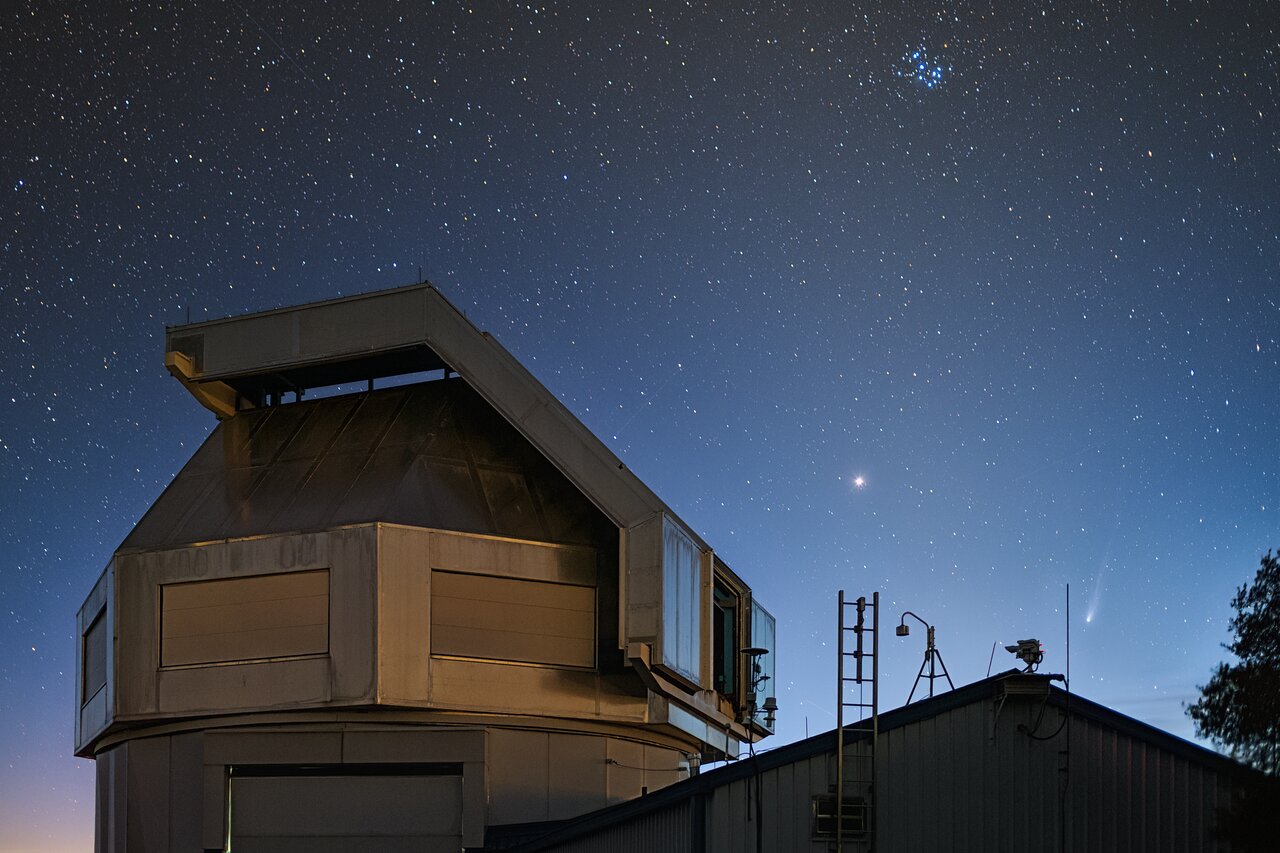
NEID Solar Telescope
A state-of-the-art radial velocity spectrograph on the WIYN 3.5m telescope at Kitt Peak National Observatory. Our group contributes to the NEID science team, particularly in the analysis of data from the NEID Solar Telescope that observes the Sun-as-a-star. This provides a unique dataset for developing and evaluating methods to characterize and mitigate stellar variability.
Habitable Zone Planet Finder (HPF)
A near-infrared spectrograph on the Hobby-Eberly Telescope designed to detect low-mass planets orbiting M dwarf stars in their habitable zones. Our group contributes to the interpretation of data from the HPF science program, with a focus on Bayesian inference and stellar-variability mitigation methods.
Mitigating Stellar Variability
A major challenge for EPRV surveys is distinguishing true planetary signals from apparent Doppler shifts caused by stellar surface phenomena — granulation, oscillations, and magnetic activity. Our group develops data-driven and physics-informed machine learning approaches (including GRASS and StellarSpectraObservationFitting.jl) to simulate and mitigate these effects.
Selected Publications
- Discovery of a Nearby Habitable Zone Super-Earth Candidate Amenable to Direct Imaging
Beard, Corey et al. (2025), AJ, 170, 279. abstract doi - Enhancing Exoplanet Surveys via Physics-informed Machine Learning
Ford, Eric B. (2025), 19, 1-10. abstract doi - The NEID Earth Twin Survey. IV. Confirming an 89 d, $m\sin i=10~\mathrmM_⊕$ Planet Orbiting a Nearby Sun-like Star
Giovinazzi, Mark R. et al. (2025), arXiv e-prints, arXiv:2508.18169. abstract doi - The NEID Earth Twin Survey. III. Survey Performance after Three Years on Sky
Gupta, Arvind F. et al. (2025), AJ, 170, 264. abstract doi - The NEID Earth Twin Survey. I. Confirmation of a 31 Day Planet Orbiting HD 86728
Gupta, Arvind F. et al. (2025), AJ, 169, 1. abstract doi - Order-by-order Modeling of Exoplanet Radial Velocity Data
Langford, Zachary et al. (2025), PASP, 137, 114503. abstract doi - Time-resolved p-mode Oscillations for Subgiant HD 142091 with NEID at WIYN
Luhn, Jacob K. et al. (2025), ApJ, 987, 168. abstract doi - Searching for Low-mass Exoplanets amid Stellar Variability with a Fixed Effects Linear Model of Line-by-line Shape Changes
Salzer, Joseph et al. (2025), AJ, 170, 179. abstract doi - Utilizing Photometry from Multiple Sources to Mitigate Stellar Variability in Precise Radial Velocities: A Case Study of Kepler-21
Beard, Corey et al. (2024), AJ, 168, 149. abstract doi - The Death of Vulcan: NEID Reveals That the Planet Candidate Orbiting HD 26965 Is Stellar Activity
Burrows, Abigail et al. (2024), AJ, 167, 243. abstract doi - Astrometry and Precise Radial Velocities Yield a Complete Orbital Solution for the Nearby Eccentric Brown Dwarf LHS 1610 b
Fitzmaurice, Evan et al. (2024), AJ, 168, 140. abstract doi - Earths within Reach: Evaluation of Strategies for Mitigating Solar Variability using 3.5 years of NEID Sun-as-a-Star Observations
Ford, Eric B. et al. (2024), arXiv e-prints, arXiv:2408.13318. abstract doi - Data-Driven Modeling of Telluric Features and Stellar Variability with StellarSpectraObservationFitting.jl
Gilbertson, Christian et al. (2024), arXiv e-prints, arXiv:2408.17289. abstract doi - GRASS. II. Simulations of Potential Granulation Noise Mitigation Methods
Palumbo, Michael L. et al. (2024), AJ, 168, 46. abstract doi - Quiet Please: Detrending Radial Velocity Variations from Stellar Activity with a Physically Motivated Spot Model
Siegel, Jared C. et al. (2024), AJ, 168, 158. abstract doi - Statistical Methods for Exoplanet Detection with Radial Velocities
Hara, Nathan C., Ford, Eric B. (2023), Annual Review of Statistics and Its Application, 10, 623-649. abstract doi - Impact of Correlated Noise on the Mass Precision of Earth-analog Planets in Radial Velocity Surveys
Luhn, Jacob K. et al. (2023), AJ, 165, 98. abstract doi - The Extreme Stellar-signals Project. III. Combining Solar Data from HARPS, HARPS-N, EXPRES, and NEID
Zhao, Lily L. et al. (2023), AJ, 166, 173. abstract doi - A Neptune-mass exoplanet in close orbit around a very low-mass star challenges formation models
{Stef\'ansson}, Gu\dhmundur et al. (2023), Science, 382, 1031-1035. abstract doi - Detection of p-mode Oscillations in HD 35833 with NEID and TESS
Gupta, Arvind F. et al. (2022), AJ, 164, 254. abstract doi - Observing the Sun as a Star: Design and Early Results from the NEID Solar Feed
Lin, Andrea S.~J. et al. (2022), AJ, 163, 184. abstract doi - GRASS: Distinguishing Planet-induced Doppler Signatures from Granulation with a Synthetic Spectra Generator
Palumbo, III, Michael L. et al. (2022), AJ, 163, 11. abstract doi - FIESTA II. Disentangling Stellar and Instrumental Variability from Exoplanetary Doppler Shifts in the Fourier Domain
Zhao, J., Ford, Eric B., Tinney, C.~G. (2022), ApJ, 935, 75. abstract doi - The EXPRES Stellar Signals Project II. State of the Field in Disentangling Photospheric Velocities
Zhao, Lily L. et al. (2022), AJ, 163, 171. abstract doi - The Warm Neptune GJ 3470b Has a Polar Orbit
{Stef\`ansson}, Gu\djmundur et al. (2022), ApJL, 931, L15. abstract doi - Extreme Precision Radial Velocity Working Group Final Report
Crass, Jonathan et al. (2021), arXiv e-prints, arXiv:2107.14291. abstract doi - Optimizing Radial Velocity Follow-up Strategies for Single-Transit Exoplanet Candidates
Gupta, Arvind F. et al. (2021), 113. abstract doi - Target Prioritization and Observing Strategies for the NEID Earth Twin Survey
Gupta, Arvind F. et al. (2021), AJ, 161, 130. abstract doi - Friends and Foes: Conditional Occurrence Rates of Exoplanet Companions and Their Impact on Radial Velocity Follow-up Surveys
He, Matthias Y., Ford, Eric B., Ragozzine, Darin (2021), AJ, 162, 216. abstract doi - A Stellar Activity F-statistic for Exoplanet Surveys (SAFE)
Holzer, Parker H. et al. (2021), AJ, 161, 272. abstract doi - Toward Extremely Precise Radial Velocities. I. Simulated Solar Spectra for Testing Exoplanet Detection Algorithms
Gilbertson, Christian, Ford, Eric B., Dumusque, Xavier (2020), Research Notes of the American Astronomical Society, 4, 59. abstract doi - Toward Extremely Precise Radial Velocities. II. A Tool for Using Multivariate Gaussian Processes to Model Stellar Activity
Gilbertson, Christian et al. (2020), ApJ, 905, 155. abstract doi - TOI-1728b: The Habitable-zone Planet Finder Confirms a Warm Super-Neptune Orbiting an M-dwarf Host
Kanodia, Shubham et al. (2020), ApJ, 899, 29. abstract doi - Quantifying the Bayesian Evidence for a Planet in Radial Velocity Data
Nelson, Benjamin E. et al. (2020), AJ, 159, 73. abstract doi - Persistent Starspot Signals on M Dwarfs: Multiwavelength Doppler Observations with the Habitable-zone Planet Finder and Keck/HIRES
Robertson, Paul et al. (2020), ApJ, 897, 125. abstract doi - The Habitable Zone Planet Finder Reveals a High Mass and Low Obliquity for the Young Neptune K2-25b
Stefansson, Gudmundur et al. (2020), AJ, 160, 192. abstract doi - A Sub-Neptune-sized Planet Transiting the M2.5 Dwarf G 9-40: Validation with the Habitable-zone Planet Finder
Stefansson, Gudmundur et al. (2020), AJ, 159, 100. abstract doi - The EXPRES Stellar-signals Project. I. Description of Data
Zhao, Lily et al. (2020), Research Notes of the American Astronomical Society, 4, 156. abstract doi - A Mini-Neptune and a Radius Valley Planet Orbiting the Nearby M2 Dwarf TOI-1266 in Its Venus Zone: Validation with the Habitable-zone Planet Finder
{Stef\'ansson}, Gu\dhmundur et al. (2020), AJ, 160, 259. abstract doi - The Habitable-Zone Planet Finder: improved flux image generation algorithms for H2RG up-the-ramp data
Ninan, J.~P. et al. (2018), 10709, 107092U. abstract doi - Insights on the Spectral Signatures of Stellar Activity and Planets from PCA
Davis, Allen B. et al. (2017), ApJ, 846, 59. abstract doi - Improving Exoplanet Detection Power: Multivariate Gaussian Process Models for Stellar Activity
Jones, David E. et al. (2017), arXiv e-prints, arXiv:1711.01318. abstract doi - State of the Field: Extreme Precision Radial Velocities
Fischer, Debra A. et al. (2016), PASP, 128, 066001. abstract doi - An empirically derived three-dimensional Laplace resonance in the Gliese 876 planetary system
Nelson, Benjamin E. et al. (2016), MNRAS, 455, 2484-2499. abstract doi - The 55 Cancri planetary system: fully self-consistent N-body constraints and a dynamical analysis
Nelson, Benjamin E. et al. (2014), MNRAS, 441, 442-451. abstract doi - RUN DMC: An Efficient, Parallel Code for Analyzing Radial Velocity Observations Using N-body Integrations and Differential Evolution Markov Chain Monte Carlo
Nelson, Benjamin, Ford, Eric B., Payne, Matthew J. (2014), ApJS, 210, 11. abstract doi - Dynamics and instabilities in exoplanetary systems
Ford, Eric B. (2008), 249, 441-446. abstract doi - Cadence optimisation and exoplanetary parameter sensitivity
Kane, Stephen R., Ford, Eric B., Ge, Jian (2008), 249, 115-118. abstract doi - Improving the Efficiency of Markov Chain Monte Carlo for Analyzing the Orbits of Extrasolar Planets
Ford, Eric B. (2006), ApJ, 642, 505-522. abstract doi - Quantifying the Uncertainty in the Orbits of Extrasolar Planets
Ford, Eric B. (2005), AJ, 129, 1706-1717. abstract doi
Software
GRASS
Granulation and Stellar Spectra Simulator. Simulates the effects of solar/stellar granulation on radial velocity measurements.
StellarSpectraObservationFitting.jl
Data-driven modeling of telluric features and stellar variability in high-resolution spectra. See also SSOFApplication for example applications.
GPLinearODEMaker.jl
provides the likelihood (and derivatives thereof) of multivariate Gaussian processes (GP) that are composed of a linear combination of a univariate GP and its derivatives. See also GLOM_RV_Example repository for example.
RVSpectML
A set of julia pacakges for analyzing Echelle spectra, optimizing for NEID solar observaitons
Fixed Effects Linear Model of Line-by-Line Shape Changes
R code implementing Fixed Effects Linear Model from Salzer et al. (2025)
FIESTA (φESTA)
FourIEr phase SpecTrum Analysis for disentangling stellar and instrumental variability from planetary Doppler shifts. Projects cross-correlation functions onto Fourier basis functions to separate line-shape changes from true RV shifts.